
25 November 2026 - Tony Tyler
Richardson Sales Performance recently surveyed 1,105 senior sales leaders to find out what firms that beat their sales targets do differently (The Revenue Edge, November 2026). One finding stood out in relation to sales training. Three practices, run together, make a firm twice as likely to hit its targets. Yet only about one in six firms manage this.
Whenever I speak with salespeople who have just been on a sales training course, they are almost always complimentary and motivated by what they learned. It's been the same for me. I've attended many courses over the years. At Jardine Lloyd Thompson plc I was even lucky enough to go on the same consultative selling course more than once in a matter of weeks, because I was organising it for the JLT Specialty team. I loved it every time. It was a great course.
The issue is what happens after the course. People drift back to old habits. It isn't intentional. It's human. Under pressure, we do what we've always done. That matters more than it first appears. A good course isn't only about improving individual skills. It's how a firm sets out its way of selling: how we prepare, how we qualify, how we run a first meeting. In short, "how we manage sales around here". When people slip back, the firm loses more than a skill. It loses consistency.
Different tactics to make training stick
Firms use a whole range of methods to reinforce sales training and develop their sales culture and processes. Some of these are shown below.
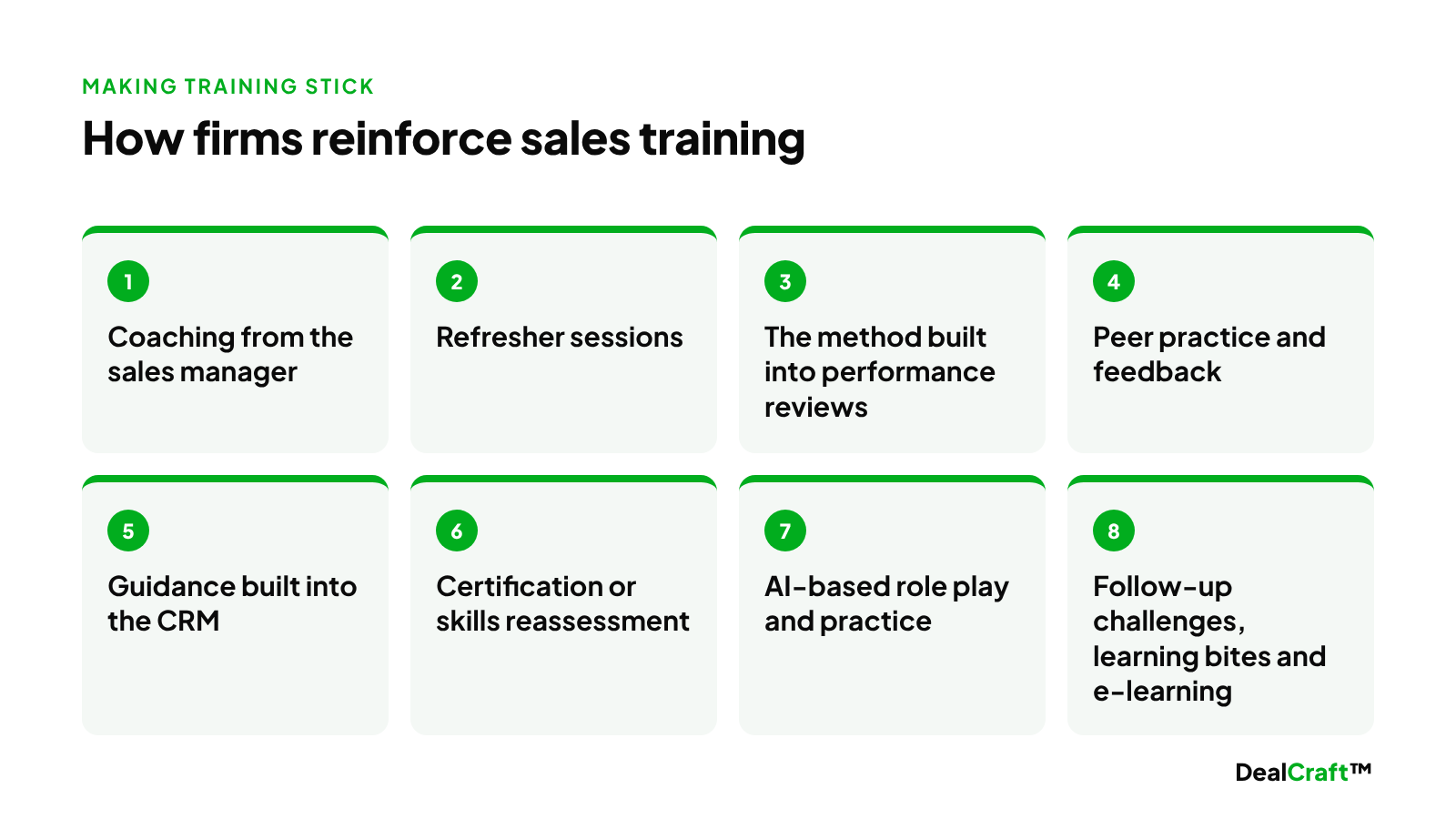
Diagram 1 - How Firms Reinforce Sales Training
What top performers do differently
Richardson's research is particularly useful because it shows what top performers do differently. They are more likely to use manager coaching, performance reviews, CRM guidance and AI practice. But the real difference comes from combining three practices.
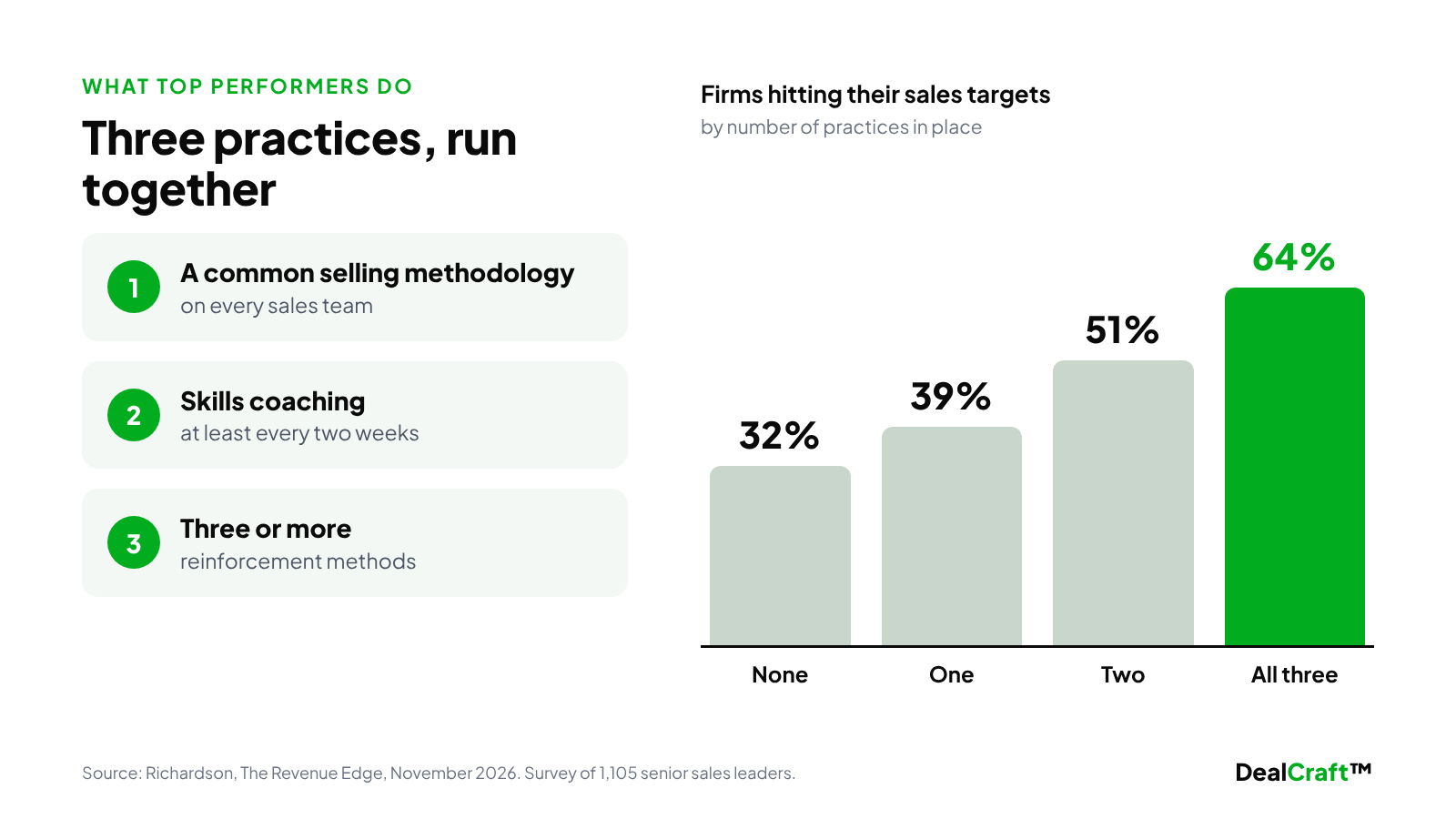
Diagram 2 - Three Practices
A common selling methodology on every sales team, not just some. Consistency matters: where more than three-quarters of salespeople apply the methodology, 60% of firms hit their targets. Where there is no common methodology, only 31% do.
Skills coaching at least every two weeks. This draws on what learning researchers call spaced repetition. In 1885 Hermann Ebbinghaus showed that new learning fades quickly unless we come back to it, and that revisiting it at intervals makes it last. A coaching conversation every fortnight does exactly that. It brings the salesperson back to what they learned, on real work, before it fades.
Three or more of the reinforcement methods in diagram 1. Reinforcement simply means anything that brings people back to what they learned and helps them use it, until it becomes a habit rather than the memory of a good course. Top performers are much more likely to use several at once: 69% use three or more, against 48% of firms that fall short of their targets.
Firms that run all three are twice as likely to hit their sales targets as firms that run none. You'd think everyone would be following this, but only about one in six firms in the study do all three. Most have a methodology, but fewer than half of even the top performers use it on every team. Only 37% of leaders say a typical salesperson gets a skills coaching conversation at least once a fortnight.
Why three practices are hard
A methodology on every team needs someone to make sure it is used on every opportunity. Coaching every two weeks needs a manager with time. Reinforcement needs someone to organise it and follow it up.
All three lean on the same scarce thing: the time of the people who lead sales teams. The Richardson survey identifies insufficient manager capacity among the obstacles holding back growth. Managers' weeks fill up with sales opportunities, pipeline reviews, forecasts and reporting among many other things. Coaching is the first thing to slip. Salespeople notice: 40% of salespeople in Salesforce's 2026 State of Sales survey say their manager's lack of time gets in the way of their development.
That is the real problem. Firms know what makes training stick. Doing it consistently takes more management time than most of them have.
Can AI help?
I believe it can, if it's the right kind of AI. Most AI tools used in sales today are general assistants. They help with research and writing, but they don't know how your firm sells, so they can't reinforce it.
A specialist AI sales co-worker is different. Take DealCraft™. It is grounded in your firm's own propositions and differentiators, and in the principles behind proven sales methods such as MEDDICC, SPIN, Challenger, the deal and account planning disciplines popularised by Miller Heiman, and the Situation–Complication–Resolution structure used across strategy consulting. That changes what happens after the course in three ways.
The method is used on every opportunity. The AI researches each prospect, prepares each meeting, qualifies each deal and shapes each insight the way the training taught. Salespeople don't have to remember the model. They work in it, every day, on live opportunities.
Managers coach from what they can see. With every opportunity prepared and qualified the same way, a manager can see across the team what is known, what is assumed and what is missing. Less time goes on chasing information, and more on coaching.
Help is there between sessions. A salesperson unsure how to build a high-gain question can ask at the moment they need it, rather than wait for the next workshop.
Training can focus on the conversation
There is a bigger prize. When AI carries the research, preparation and analysis, training doesn't need to spend its time on process and templates. It can focus on what happens in the room, the part no technology can do and the part that makes the difference to the sale. Asking the question that opens a buyer up. Handling an objection with confidence. Reading body language and what isn't being said. Building agreement across a buying group.
Less to learn about process means more time for the skills that win business, and a better chance the skills stick.
Training will always be where good selling starts. The firms that get the most from it will be the ones that stop relying on spare management time to keep it going.
Book a demo to see how DealCraft™ keeps your sales method alive on every opportunity